SB15: When Is a Safety Meeting More Than Just a Meeting?
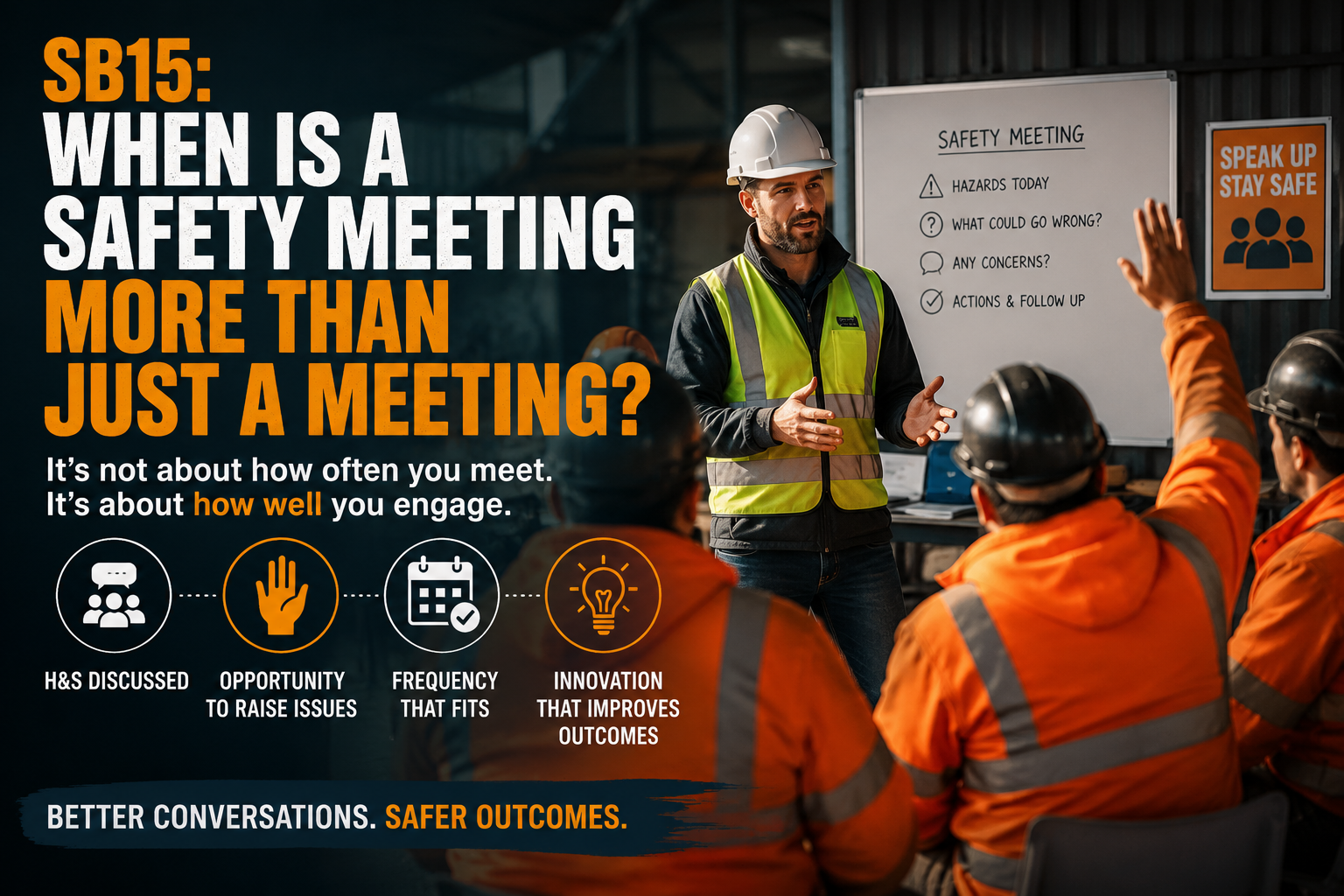
SB15: When Is a Safety Meeting More Than Just a Meeting?
As an auditor, one of the easiest things I can be shown is a toolbox meeting.
One of the harder things to establish is whether that toolbox meeting is actually doing what it is supposed to do.
That distinction sits right at the heart of SB15 in the Tōtika Category 1 assessment.
The question sounds straightforward:
Do you have regular meetings with workers where health and safety matters are discussed, and workers have the opportunity to raise issues?
Then comes the important second part:
How often do they occur, and why is that frequency appropriate?
At Level 3, Tōtika is looking for regular meetings with workers, including contractors, where health and safety matters are discussed. The frequency might be at the start of every job, daily, weekly, fortnightly, monthly or something else entirely. What matters is that the frequency makes sense for the nature of the operation.
Sounds easy.
It is not quite as simple as it first appears.
More meetings do not automatically mean better safety
One of the misconceptions I see is that frequency equals maturity.
It does not.
A contractor conducting a prestart every morning does not automatically have a better health and safety meeting process than a small business meeting fortnightly.
Think about two businesses.
Business A conducts a toolbox meeting every morning. Workers stand around while a supervisor reads out the day's safety message. Everyone signs the form and gets to work.
Business B meets fortnightly. Health and safety is a standing topic. Workers raise issues encountered during work, proposed changes are discussed, actions are allocated and matters are followed through.
Which has the stronger process?
Potentially Business B.
SB15 is not a competition to see who can accumulate the greatest number of toolbox forms.
The question is whether the meeting arrangements are appropriate and whether they achieve their intended purpose.
A signature does not tell me much
As an auditor, a sheet containing twelve signatures tells me twelve people probably signed something.
It does not necessarily tell me what happened in the meeting.
It does not tell me whether health and safety was meaningfully discussed.
It does not tell me whether workers could raise concerns.
And it certainly does not tell me whether anything changed as a result.
This becomes particularly important when assessing toolbox and prestart records.
A good record might show:
Health and safety topics discussed.
Hazards or changing conditions considered.
Questions or concerns raised by workers.
Suggestions made.
Actions agreed.
Responsibility for those actions.
Follow up from previous discussions.
Not every meeting needs to contain all of these things.
And workers certainly do not need to invent a safety concern every Tuesday morning just so the paperwork looks impressive.
The important distinction is whether workers have the opportunity to speak.
"No issues raised" can be perfectly acceptable
This is another area where assessment can become unnecessarily bureaucratic.
Imagine a toolbox form says:
"Any health and safety concerns?"
"None raised."
That does not mean the meeting failed.
If workers genuinely had the opportunity to raise concerns and nobody had anything to raise that day, that is perfectly reasonable.
The assessment question is not:
"Did a worker complain at every meeting?"
It is whether workers have the opportunity to raise issues.
That distinction matters.
Contractors count too
There is another small phrase in SB15 that should not be overlooked.
The criterion refers to meetings with workers, including contractors.
Tōtika also defines "worker" broadly. It includes employees, contractors, subcontractor employees, labour hire workers, apprentices, trainees, work experience students, volunteers and others whose work is influenced or directed by the organisation.
So an organisation with five employees and fifteen regular contractors should think carefully before saying:
"We discuss safety with all our staff."
The real question is whether the people exposed to, and involved in, the work are appropriately included.
What does "appropriate frequency" actually mean?
This is where professional judgement enters the assessment.
There is no magic number.
A small professional services organisation might reasonably discuss health and safety during monthly team meetings.
A field service business with changing work locations might use daily prestarts.
A construction contractor might have several layers:
Daily prestarts.
Weekly toolbox meetings.
Project meetings.
Monthly company health and safety meetings.
None of those arrangements is automatically right or wrong.
The organisation should be able to explain why its approach makes sense.
For example:
"We hold a prestart before each new job because the work environment and hazards change between client sites."
That tells me something.
Compare it with:
"We have monthly meetings because our policy says monthly."
That tells me considerably less.
The strongest organisations understand why they have chosen their meeting frequency rather than simply inheriting it from a template.
Then we get to Level 4: innovation
This is where SB15 becomes particularly interesting.
Tōtika says that Level 4 requires the organisation to meet the minimum requirements and demonstrate "innovation in how the employer meets with workers to discuss H&S matters."
That word deserves some scrutiny.
What exactly is innovation?
Because if we are not careful, almost anything modern can start being labelled innovative.
"We use Teams."
Not necessarily innovative.
"We have an app."
Not necessarily innovative.
"We use QR codes."
Again, not necessarily innovative.
"We replaced a paper toolbox form with an iPad."
Useful? Absolutely.
Efficient? Probably.
Innovative?
Not automatically.
That is digitisation.
Innovation should solve a problem
When I assess innovation, I want to understand what has actually improved.
What problem existed?
What did the organisation do differently?
Why was that approach appropriate?
What changed as a result?
That is a much more useful test.
Consider a geographically dispersed workforce.
Previously, field workers rarely contributed to the monthly safety meeting because they were spread across multiple locations.
The organisation redesigns its approach.
Workers can submit issues throughout the week using a simple digital mechanism.
Those issues feed directly into the safety meeting.
Remote workers can join discussions live or asynchronously.
Actions are assigned and visible to the workforce.
The person who raised an issue receives feedback about what happened.
Participation data identifies teams or locations that are becoming disconnected from safety discussions.
Now we are getting somewhere.
The technology is not the innovation.
The redesigned participation process is.
Innovation does not have to involve technology
This is equally important.
Some of the best safety innovations are remarkably simple.
Imagine a business discovers that its toolbox meetings are dominated by supervisors.
Workers rarely speak.
Instead of buying software, management changes the meeting format.
Each week a different worker leads part of the toolbox.
The team discusses one real job from the previous week.
Workers identify what made the job difficult.
The discussion focuses on how work actually occurred rather than how the procedure says it should occur.
Actions are captured and followed through.
Over time, workers who previously said very little begin contributing.
That could be considerably more innovative than purchasing another app.
Innovation is not synonymous with technology.
Novelty is not enough either
Something being unusual does not automatically make it good.
An organisation could introduce virtual reality toolbox meetings, artificial intelligence generated safety briefings and holographic supervisors.
Very exciting.
But if workers still cannot raise a concern, nobody follows up actions and the process has no measurable benefit, we have created expensive theatre.
Innovation should improve the outcome.
For SB15, that outcome is fundamentally about better health and safety discussion between the organisation and its workers.
Innovation should also be contextual
There is another trap.
What is innovative for one organisation may be completely ordinary for another.
A sophisticated national contractor introducing Microsoft Teams meetings is unlikely to convince me that videoconferencing itself represents innovation.
A small remote business developing a simple mechanism that successfully connects isolated workers into regular safety discussions may have a much stronger argument.
Context matters.
So does the problem being solved.
A useful test for innovation
When someone tells me their SB15 approach is innovative, these are effectively the questions running through my head:
What was the previous problem or limitation?
What have you changed?
Why is the approach different from ordinary meeting practice?
How does it improve worker access, participation, engagement or the quality of discussion?
Is it actually being used?
Can you demonstrate the improvement?
If those questions can be answered convincingly, there may be a genuine Level 4 story.
If the answer is simply:
"We use an app."
I am probably not there yet.
Small businesses should not try to imitate large businesses
Tōtika expressly recognises that small businesses may demonstrate the core requirements differently from larger and more complex organisations.
That principle is particularly relevant to SB15.
If you employ four people who work together every day, creating a twelve person health and safety committee would be absurd.
You do not need corporate bureaucracy to demonstrate good health and safety.
What you need is a credible process appropriate to your business.
Perhaps the team has a structured safety discussion every Monday morning and a prestart whenever work conditions materially change.
Great.
Show me.
Explain why it works.
Show me that health and safety is actually discussed.
Show me that workers can speak.
That can be entirely appropriate.
What I am really looking for as an auditor
When reviewing SB15, I am ultimately trying to establish five things.
First, do these meetings or structured discussions actually occur?
Second, is health and safety genuinely discussed?
Third, can workers contribute and raise issues?
Fourth, is the frequency appropriate to the organisation and its work?
Fifth, can the organisation explain why?
If you are seeking Level 4, there is another question.
What are you doing differently that demonstrably makes this process better?
That last word matters.
Better.
Not newer.
Not shinier.
Not digital.
Better.
The paperwork is evidence. It is not the objective.
This is perhaps the most important lesson in SB15.
A toolbox form is not a safety meeting.
Minutes are not worker engagement.
A signature is not consultation.
An app is not innovation.
They are evidence and mechanisms.
The real objective is a functioning conversation about health and safety between an organisation and the people doing the work.
Good organisations create opportunities for those conversations.
Better organisations listen to what comes back.
And genuinely mature organisations continually improve the way those conversations happen.
That is what I would be looking for when I open your SB15 evidence.