
Does Every Tōtika Question Need Evidence?
Does Every Tōtika Question Need Evidence?
One of the biggest myths we hear from businesses completing their Tōtika assessment is this:
"I've got to upload evidence for every single question."
The good news is that simply isn't true.
In fact, one of the most common reasons businesses take far longer than they need to complete their assessment is because they spend hours searching for documents that were never required in the first place.
The secret is understanding what the question is actually asking.
Read the criteria before you start uploading files
Every question in a Tōtika assessment includes assessment criteria. Those criteria tell you exactly what an assessor is looking for.
Sometimes you'll see wording like:
"Provide evidence."
"Upload a copy of..."
"Supply an example..."
When you see those words, you'll need supporting documentation.
However, other questions simply ask you to describe your process.
That means the assessor is looking for a complete and accurate explanation, not necessarily a document.
Understanding this difference can save you hours.
A perfect example
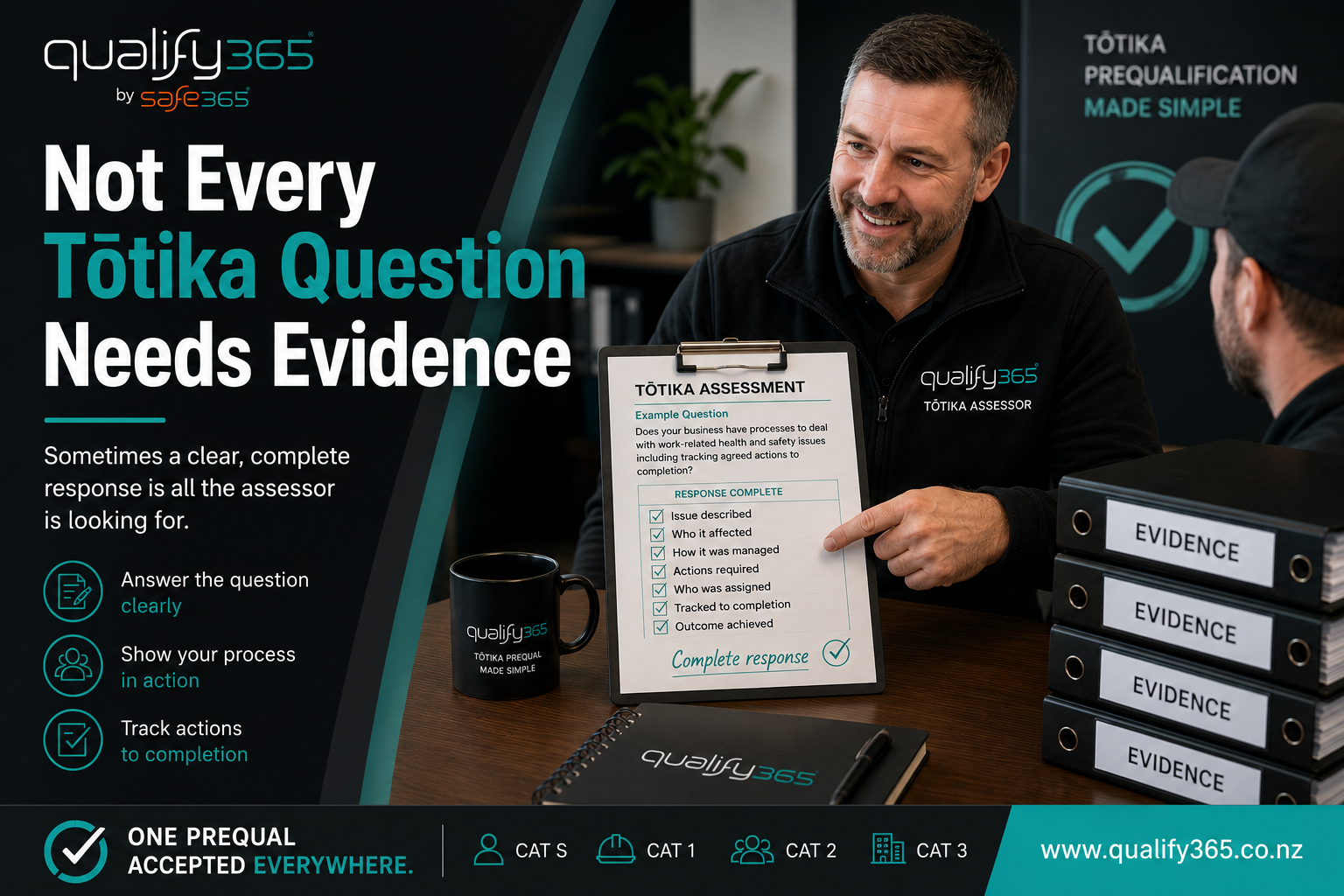
One question asks whether your business has processes to deal with work related health and safety issues, including tracking agreed actions through to completion.
At first glance, many businesses immediately start looking for incident reports, hazard registers or corrective action logs.
But if you read the assessment criteria carefully, you'll notice something important.
The criteria ask you to describe an example that includes:
The health and safety issue.
Who it affected.
How it was managed.
What actions were required.
Who those actions were assigned to.
How they were tracked until they were completed.
The final outcome.
Notice what's missing?
Nowhere does it say you must upload evidence.
Tell the story
Think about it as if you're explaining the situation to another business owner.
Perhaps one of your workers discovered damaged electrical equipment during a prestart inspection.
You stopped work immediately.
The equipment was removed from service.
Your supervisor arranged a replacement.
The action was recorded in your corrective action register.
The replacement was confirmed before work resumed.
The issue was closed and everyone was reminded to inspect equipment before use.
That's exactly what an assessor wants to understand.
Can your business identify a problem?
Can you manage it appropriately?
Can you assign responsibility?
Can you make sure the action is actually completed?
Can you demonstrate that the issue was resolved?
If your written response clearly answers those questions, you've demonstrated the process.
Does evidence still help?
Absolutely.
If you already have a corrective action register, incident report or hazard register that supports your example, there's no harm in uploading it.
It may even provide additional confidence for the assessor.
The important point is that if the assessment criteria don't ask for evidence, your assessment shouldn't depend on having uploaded it.
A clear, well structured response that addresses every part of the criteria can be all that's needed.
Our advice
Before you start hunting through folders looking for documents, stop for a moment and read the assessment criteria carefully.
Ask yourself:
Is the assessor asking me to provide evidence?
Or are they asking me to explain my process?
Knowing the difference can save you time, reduce frustration and make your assessment much easier to complete.
At Qualify365, we assess businesses against the published Tōtika assessment criteria. We don't expect you to upload documents that aren't required. Our goal is to help you understand exactly what each question is asking so you can focus your effort where it matters most.
If you're unsure whether a question requires evidence or simply a written response, get in touch with the Qualify365 team. Sometimes the quickest way to complete your assessment is simply knowing what the assessor is really looking for.